CIF 2027–28: What’s changed and how to prepare your application
The Condition Improvement Fund (CIF) 2027–28 round is now open, giving eligible academies, sixth-form colleges and voluntary-aided schools an opportunity to secure capital funding for significant condition, compliance and health and safety issues across their estates.
The DfE plans to replace CIF with a new programme by autumn 2028, meaning this round is likely to be one of the final opportunities for eligible schools to secure funding through the existing competitive bidding process.
Competition remains high. In 2026–27, 40% of schools that applied were successful, while 32% of submitted projects secured funding. A strong, well-evidenced application is therefore essential for schools seeking to secure investment.
The 2027–28 guidance introduces changes to assessment weightings, project planning and application requirements. We’ve reviewed the key updates to explain what they mean for applicants and what to consider when developing an application.
What’s changed in the CIF 2027–28 guidance?
The latest guidance introduces important requirements and clarifications that applicants should understand before preparing their submissions.
Changes to assessment weightings
Applications are assessed against three weighted criteria. For 2027–28, the balance has shifted, with project planning accounting for a greater proportion of the overall score.
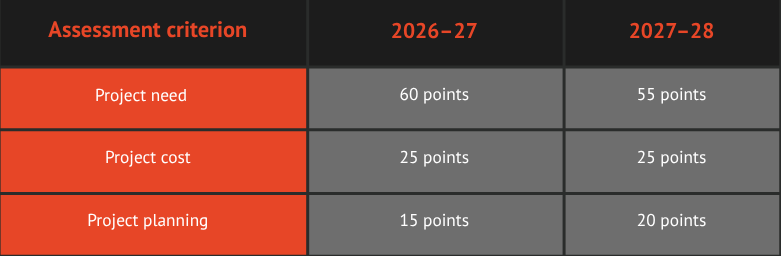
Project need remains the largest part of the assessment, making it essential to demonstrate the urgency and impact of the condition issue with robust supporting evidence. Cost remains unchanged, while the increased weighting for project planning reinforces the importance of a clearly defined scope, a justified solution, accurate costings and a realistic delivery plan.
Costed options appraisals are now mandatory
One of the most significant changes is the requirement for a bespoke costed options appraisal for every CIF application.
The appraisal must demonstrate that alternative solutions have been properly considered, including the costs, benefits and risks associated with each option. Applicants should explain why their preferred solution is the most appropriate and cost-effective way to address the identified need.
Evidencing technical adviser use and procurement
Schools appointing external technical advisers must ensure that their procurement process is compliant. This applies to no-win, no-fee arrangements as well as other forms of appointment.
The latest guidance places greater emphasis on demonstrating how the adviser was selected and retaining evidence of the process.
Where a school chooses to manage a project without a technical adviser, the person responsible must have the appropriate experience and/or qualifications for the role. This includes understanding relevant statutory duties and the requirements of the Construction (Design and Management) Regulations 2015.
The application form must contain the full project narrative
The online application form is the primary source of information used for assessment. All sections should be completed fully, with supporting documents used to provide evidence and additional technical detail rather than substitute for answers in the form.
Applicants should clearly explain the project need, proposed works, risks and expected outcomes. References such as “see attached” or “refer to supporting documents” should not replace a complete response.
Supporting document limits are more clearly defined
For the 2027–28 round, supporting documents for project need, project planning and cost must comply with the following limits:
Maximum file size of 1MB per document
Maximum of 50 pages per document
Minimum font size of Arial 11
Evidence beyond the stated limits will not be considered as part of the assessment. Applicants should therefore review their documents before uploading them, removing unnecessary material while retaining the information needed to substantiate the case for investment.
Missing or incorrect documents carry a clear risk
The guidance makes clear that the DfE is not obliged to contact applicants about missing or incorrect supporting documents. It is the applicant's responsibility to ensure that all required documentation is submitted in full by the application deadline. Applications that are incomplete, incorrect or missing required documentation are unlikely to score highly enough to be successful.
Care is also needed with the CIF declaration, which must be signed by hand, dated and submitted as a PDF. Where the required CIF declaration form is not submitted, the application may be disqualified.
If an applicant identifies an error or omission after submission, they must contact the DfE through its Customer Help Portal by the 9th December 2026 to request that the application be unsubmitted. Processing may take up to three working days, and changes cannot be made after the deadline. A thorough review well before submission is therefore essential.
Consider whether the Risk Protection Arrangement applies
Clarification that any works which may be eligible for cover under the Risk Protection Arrangement (RPA) should be submitted through the RPA process in the first instance. Where a CIF application relates to the same works, any successful application will be placed on hold pending the outcome of the RPA claim.
What else should applicants consider?
Condition survey evidence must be current and relevant
Condition surveys remain central to demonstrating project need. Surveys must not be older than the 1st October 2023 and should be independent and impartial.
The evidence should clearly explain the current condition of the affected building elements and the consequences of delaying or failing to undertake the proposed works. Additional specialist reports may be needed where the survey alone does not provide sufficient detail.
Can schools submit more than one CIF application?
Eligible schools can submit more than one CIF application where they have multiple significant condition needs. However, applicants should consider whether proposed projects genuinely represent separate and distinct needs or would be better approached as a single, coordinated programme of works.
Our analysis of the 2026–27 results found that around 20% of successful schools secured funding for two projects. Where multiple applications are planned, each should present a clear and distinct case for investment, supported by relevant evidence and a project-specific costed options appraisal.
Understanding your estate condition and strategic priorities
A CIF application should demonstrate how the proposed project fits within the institution’s wider estate strategy, rather than presenting it as an isolated funding request. It should be clear why the project is needed, how it aligns with wider estate priorities and why it requires capital investment.
The DfE’s School Estate Management Standards, Estate Management Competency Framework and Good Estate Management for Schools guidance provide a framework for assessing estate condition, managing risks and planning investment over the longer term.
Condition survey findings, asset management plans and estate strategies can help evidence the project’s place within this wider estate plan. Together, these should support a clear rationale for the proposed works, demonstrating how they address identified estate needs and fit within the institution’s investment priorities.
Preparing your CIF application
With the application window open and the deadline approaching, applicants should ensure their bids clearly demonstrate the need for investment, justify the proposed solution and provide robust supporting evidence.
Review the latest DfE guidance, ensure the costed options appraisal and procurement requirements are addressed, and check that all supporting documents and the signed declaration meet the submission requirements.
Our CIF 2027–28 application checklist brings the key requirements together to help you review your application before submission.
Key dates for CIF 2027–28
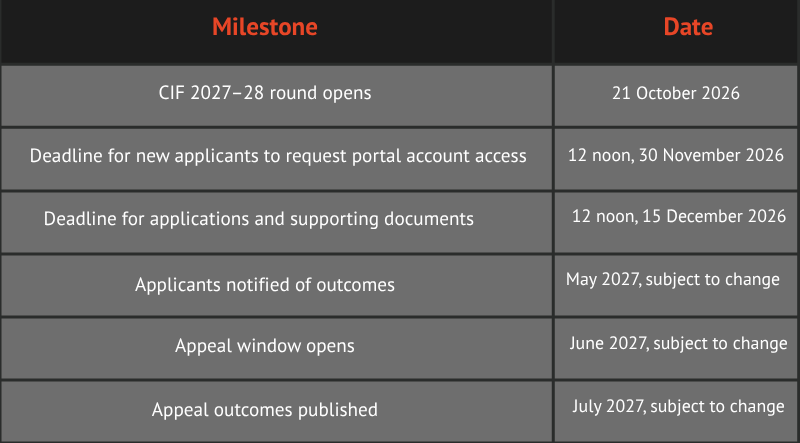
The DfE recommends beginning the online application at least 14 working days before the submission deadline. Schools should allow additional time for technical evidence, cost planning, procurement records and final checks.
Download our CIF 2027–28 application checklist
The updated guidance introduces detailed requirements across project need, planning, cost, procurement and supporting evidence. Keeping track of these requirements can help schools identify gaps early and avoid preventable errors.
S2e’s CIF 2027–28 application checklist provides a practical reference to help you organise your preparation and review key requirements before submitting your bid.
Use the checklist alongside the latest DfE guidance to help structure your preparation, gather the relevant evidence and check that your application is ready for submission.
For a wider view of funding outcomes, success rates, project types and regional variation, read our latest CIF insights.
Need support with your CIF application?
S2e’s education estates team can support with identifying priorities, developing technical evidence, preparing costings and strengthening applications. Our qualified chartered building surveyors have over a decade of experience supporting CIF applications, available on a no-win, no-fee basis.
To discuss a potential application, contact us at enquire@s2e.org.uk or call 0116 507 0130.